On a summer evening the whole metropolitan coast turns to face the same way. Adelaide’s beaches look west across Gulf St Vincent, so every jetty from Semaphore in the north to Brighton in the south gets the same sunset, and on a warm night each one fills with people walking out to watch it. That is why choosing between the Adelaide beach suburbs has less to do with the sand, which is good almost everywhere, and more to do with what surrounds it: the main street, the food, the train line, the pace, and how far you are willing to be from the city.
This guide compares the three beach suburbs most visitors weigh up as a base — Semaphore, Henley Beach and Brighton — against the obvious benchmark, Glenelg, with a few quieter alternatives at the end. It is about where to stay and what each place is like to live in for a week, not a ranking of beaches; for that, see our best beaches in Adelaide guide. Distances, transport and landmark details were checked in September 2026. Timetables change, so confirm your service in the Adelaide Metro journey planner before relying on it.
The beach suburbs at a glance
| Suburb | From the CBD | Getting to the city | The feel | Best for | The catch |
|---|---|---|---|---|---|
| Semaphore | About 14km north-west | Train from Glanville station on the Outer Harbor line, every 30 minutes | Old-fashioned seaside town, heritage main street | Families, character, budget stays | Furthest from the city; quiet at night |
| Henley Beach | About 10km west | Buses to the city and to Glenelg; no train | Foreshore dining, sunsets, relaxed and local | Couples, food lovers, sunset walks | Bus-only; busy parking on summer nights |
| Brighton | About 12km south-west | Train from Brighton station on the Seaford line | Calm, residential, easy-going café strip | Swimmers, families, anyone wanting the train | Few hotels; little nightlife |
| Glenelg (benchmark) | About 11km south-west | Tram straight into the city | Busy, touristy, lots of choice | First-timers without a car | Crowds and higher prices |
How to choose, in one minute
- No car? Glenelg (tram) or Brighton (train) keep the city within easy reach. Semaphore works by train too, but the station is a walk from the beach.
- Here to eat? Henley Beach, where the restaurants face the sea across the square.
- Travelling with kids on a budget? Semaphore, with its carousel, waterslides, jetty and wide, gentle beach.
- Want peace and a calm swim? Brighton, whose beach Surf Life Saving rates in its least hazardous category.
- Want nightlife and every option on the doorstep? Glenelg, and accept the crowds.
Semaphore: the old-fashioned seaside town
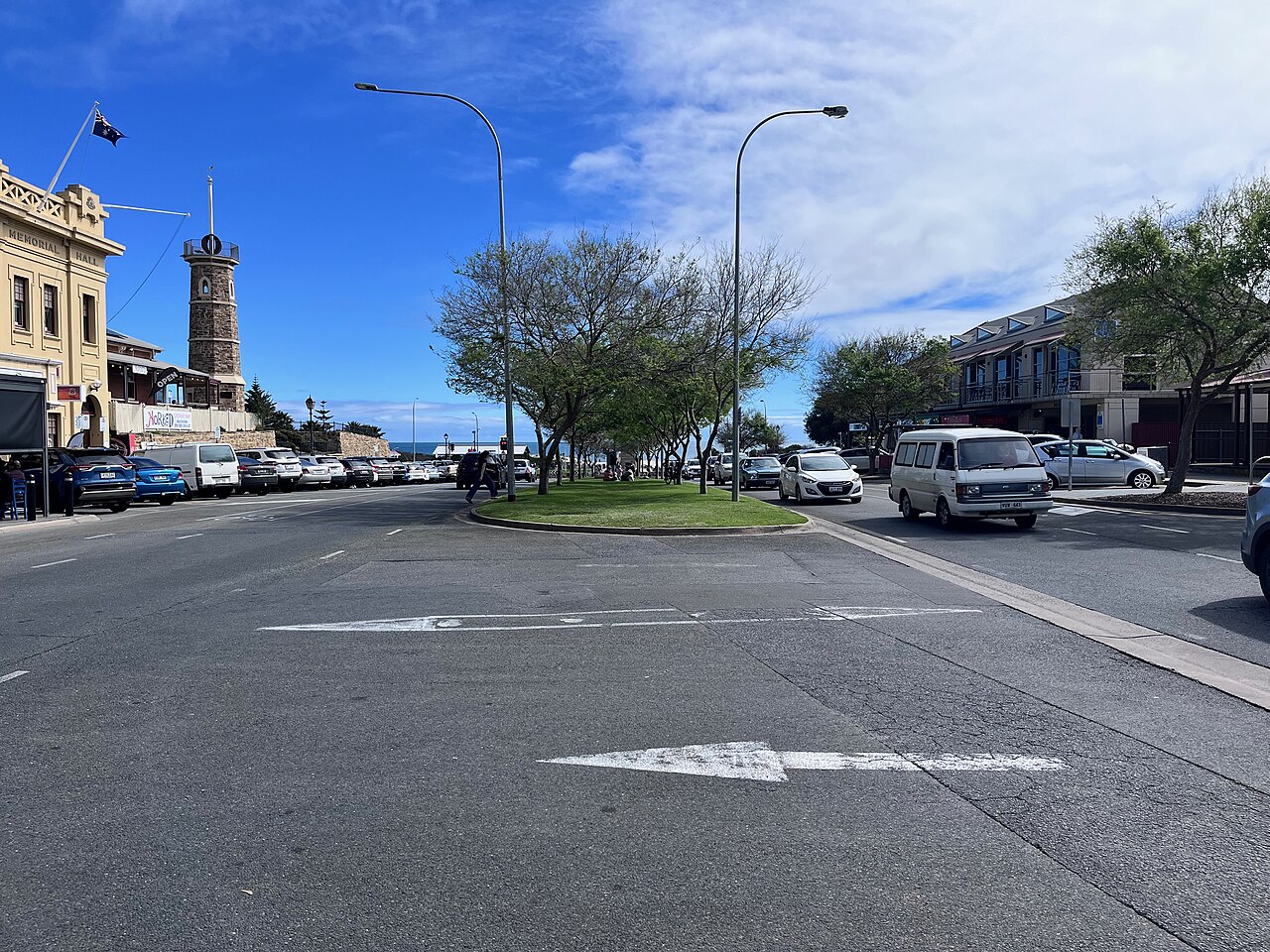
Semaphore, about 14km from the city centre on the Lefevre Peninsula, feels like a seaside town that happens to be part of a city. Its name comes from the 1850s, when signals were sent from masts on this shore to ships in the gulf and to Port Adelaide. Most of what visitors love dates from the decades after. The jetty was completed in 1860 and once ran 652 metres into the gulf. Storm damage in the 1930s cut it back, and it now reaches 585 metres, still a fine walk. The Time Ball Tower, built in 1875, once dropped a ball at a set time each day so ships’ captains could check their chronometers.
The foreshore is built for families. A merry-go-round installed in 1928, the largest in Australia at the time, still turns, and there is a small adventure park with waterslides beside it. The beach is wide and gentle. The Semaphore Road strip, which runs inland from the foreshore, was voted South Australia’s best main street in a 2014 People’s Choice award. It is lined with cafés, pubs, op shops, antique and vintage stores and Victorian and Edwardian buildings, and it has the Odeon Star, which opened on 22 May 1920 as the Wondergraph Picture Palace and is the oldest purpose-built cinema in Adelaide.
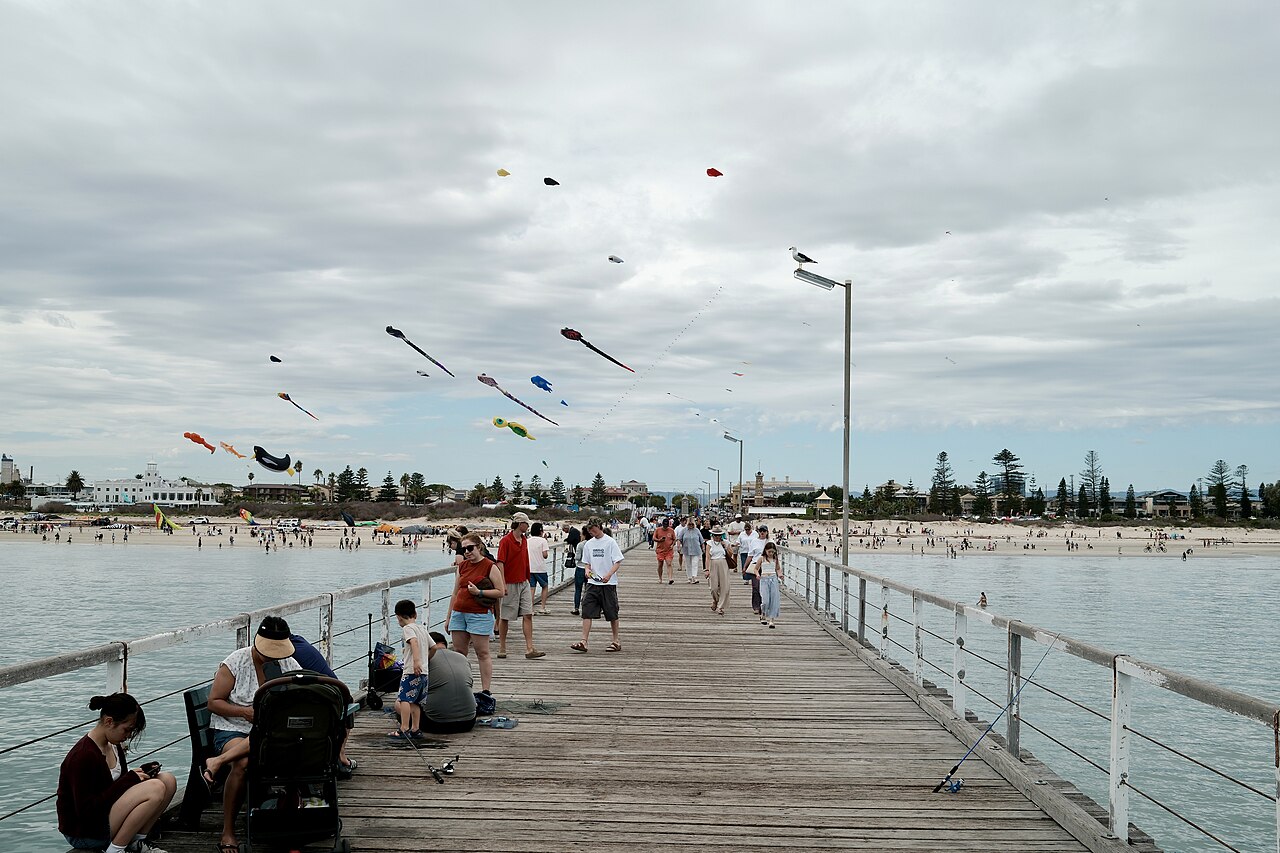
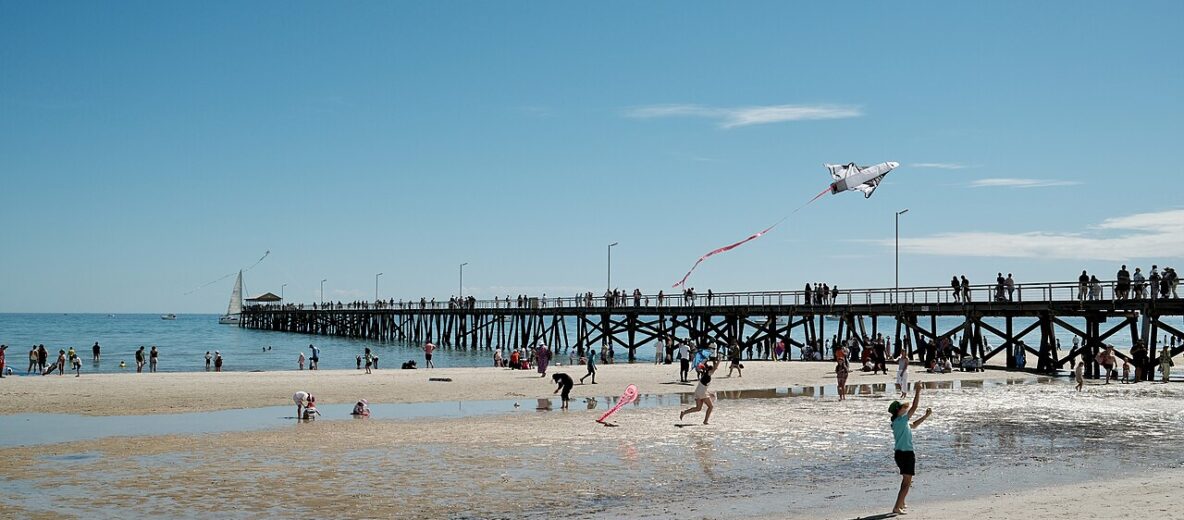
A little further along the foreshore, Fort Glanville is a restored 1880s coastal fort, part of the defences built when the colony worried about a Russian naval raid. The annual kite festival fills the sky over the jetty, and just to the north, Largs Bay has its own jetty and the grand old Largs Pier Hotel of 1882. Port Adelaide, with its maritime and railway museums and the dolphins of the Port River, is ten minutes’ drive inland. See our Port Adelaide guide.
Getting to and from the city
The nearest station is Glanville, on the Outer Harbor line, with trains to the city every 30 minutes, every day. It sits at the inland end of Semaphore Road, so from the platform it is a walk of 20 minutes or so down the main street to the jetty — pleasant, but worth knowing with luggage or small children. Several bus routes also serve the area. By car, the city is 20–30 minutes away depending on traffic.
Staying in Semaphore
Accommodation is mostly holiday rentals, cottages and small guesthouses rather than hotels, which suits families and longer stays, and it tends to cost less than equivalent places in Glenelg. The beachfront holiday parks along this stretch of coast, such as Discovery Parks Adelaide Beachfront, are popular with caravanners and families — book ahead for January and April.
The honest verdict: Semaphore has the most character of the three and the best value, and it is lovely for a family week in summer. But it is the furthest from the city, the evenings are quiet, and if you plan to spend most days in the CBD or the wine regions, the extra travel adds up.
Henley Beach: foreshore dining and sunsets
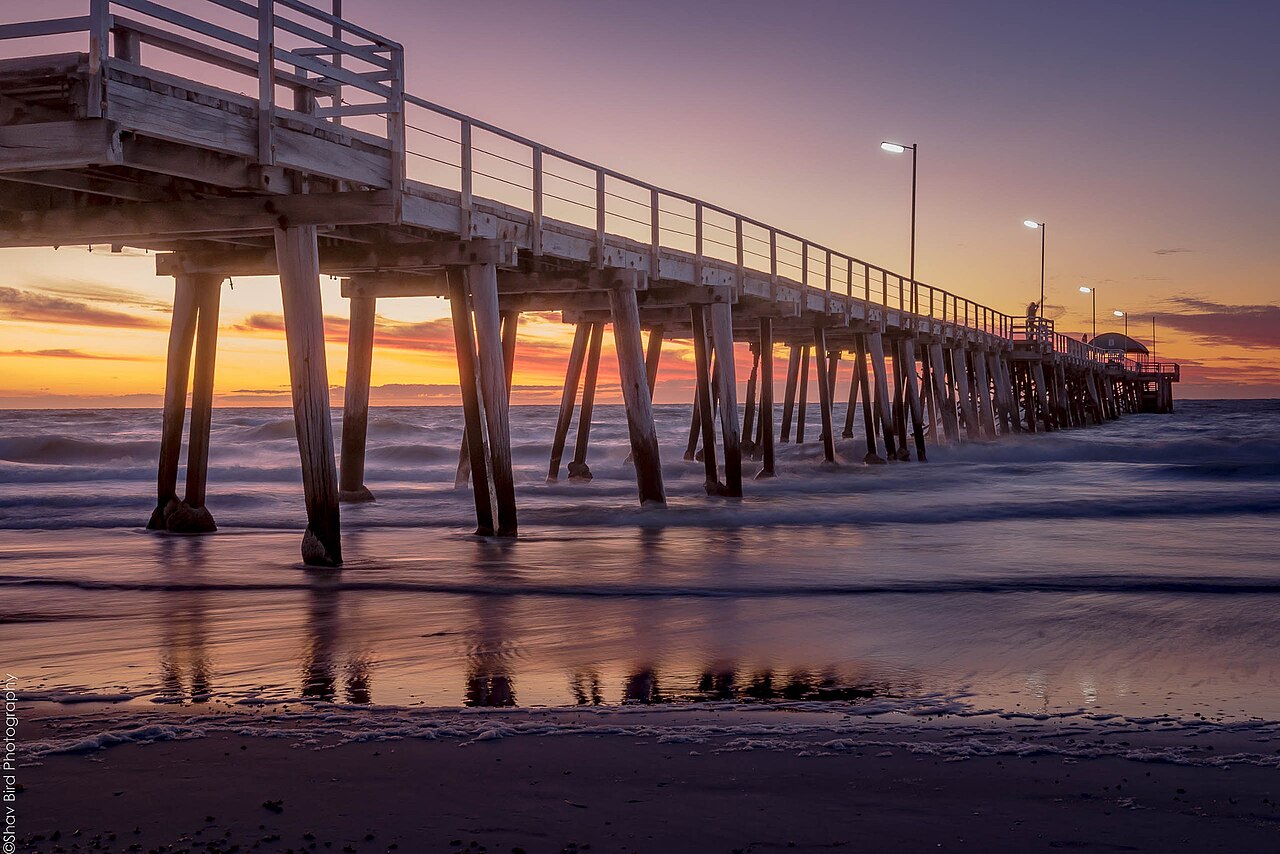
Henley Beach is only 9.7km west of the city centre, closer than any of the others, and it has built its reputation on one thing: eating and drinking by the sea. Henley Square, behind the jetty on the Esplanade, was redeveloped into a proper seaside town square with the restaurants, cafés and bars facing the water. On a warm evening it is the most sociable place on the coast. Seafood is the local speciality, and a parcel of fish and chips eaten on the sand while the sun drops behind the jetty is about as Adelaide as a summer night gets.
Away from the square, Henley is residential and relaxed, with the Esplanade lined by beach houses old and new and the coastal path running along the dunes. Walk or cycle north and you reach Grange, with its own jetty and a quieter shoreline. Go south and the path continues past West Beach towards Glenelg. The sunsets are the draw every evening — see our waterfront dining guide for tables with the best view of them.
Getting to and from the city
Henley Beach has no train. The old railway line closed in 1957, and Adelaide Metro buses now run to the city and to Glenelg. The buses are regular and straightforward, but slower than a train in peak hour. Grange, the next suburb north, is the end of the Grange railway line, which is an option if you are staying at the northern end. By car, the city is 15–25 minutes away, and the airport is close — one of the reasons Henley is popular for the first and last nights of a trip.
Staying in Henley Beach
Expect apartments, townhouses and holiday rentals, many with sea views, rather than big hotels. Prices sit between Semaphore and Glenelg, and anything facing the square or the Esplanade books out early for summer weekends. Our Adelaide Airbnb guide covers the rental options along this coast.
The honest verdict: for couples and anyone who plans their day around dinner, Henley is the pick. It is also the closest beach base to the city and the airport. The downsides are the lack of a train, summer-evening parking around the square, and not much to do when the weather turns.
Brighton: the calm, easy one
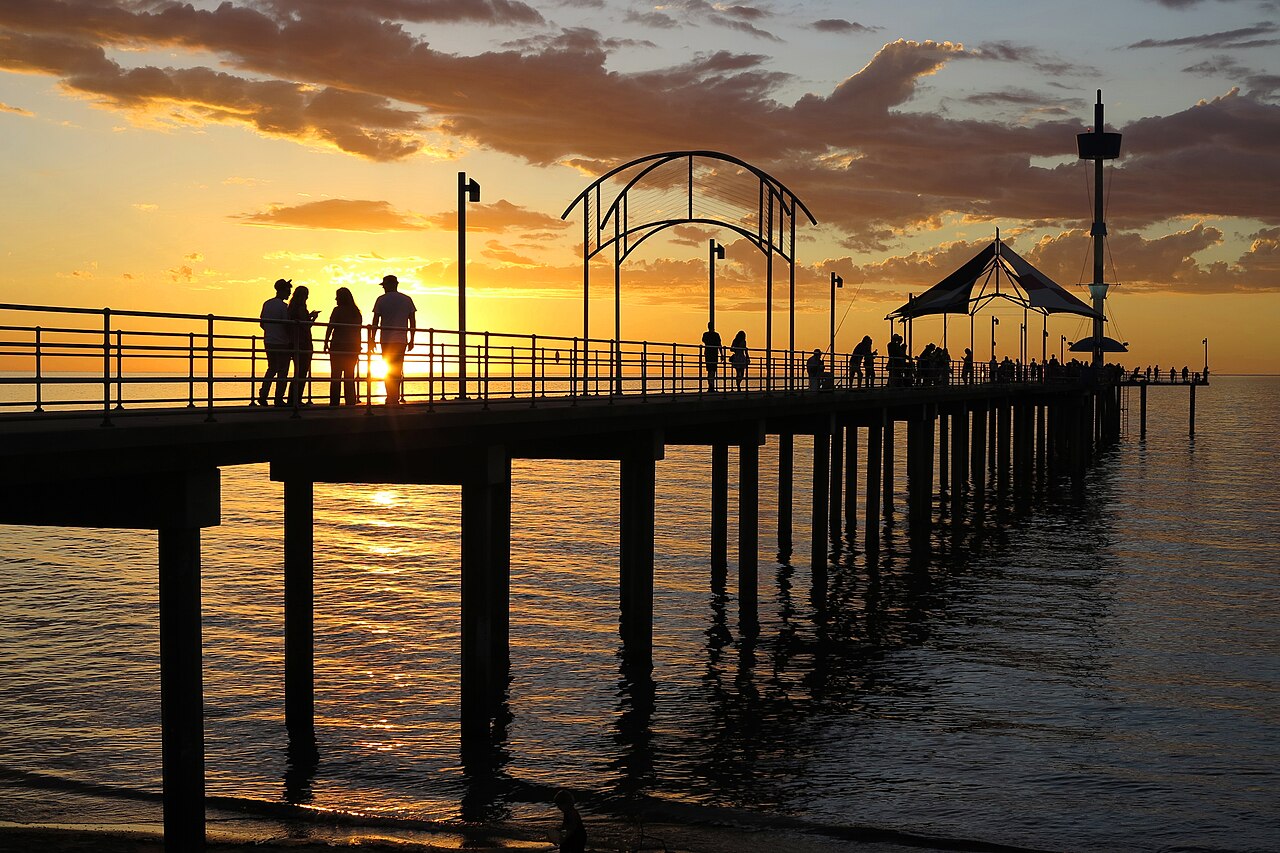
Brighton sits between Glenelg and Seacliff, and it is the suburb that locals who know the coast often choose for themselves. The beach is long, sandy and calm. Surf Life Saving rates it in its least hazardous category, and the Brighton Surf Life Saving Club patrols it on weekends and public holidays from November to March. That makes it a natural choice for families with young swimmers and for adults who actually want to swim laps rather than wade.
The heart of the suburb is Jetty Road, Brighton — not to be confused with the much busier Jetty Road in Glenelg — a low-key strip of cafés, restaurants and shops running down to the Esplanade and the Esplanade Hotel, known to everyone as the Espy. The Windsor Theatre, which opened in 1925, still shows films. The first Brighton jetty was built in 1886 and stood for more than a century before winter storms in 1994 wrecked it. Its replacement is the one you walk today, and it is the centre of the suburb’s biggest day: the Brighton Jetty Classic, held on the first Sunday in February, with a 1,500-metre open-water swim and a 400-metre course for first-timers. It is the largest open-water swim in South Australia.
Getting to and from the city
Brighton is the easiest of the three by public transport. Brighton station is on the Seaford line, and the train runs straight into Adelaide Railway Station on North Terrace in around 20–25 minutes. Glenelg is a walk or cycle of three or four kilometres north along the Esplanade, or a short bus ride. By car, allow 20–30 minutes to the CBD.
Staying in Brighton
There are fewer places to stay than in Glenelg, mostly apartments, townhouses and holiday rentals along and near the Esplanade. That is part of the appeal — Brighton does not feel like a tourist town — but it means booking early for summer, and choosing Glenelg if you want a full-service hotel.
The honest verdict: Brighton is the best all-round base for a relaxed beach holiday with easy access to the city. You get a train, a calm swimming beach, a pleasant café strip and Glenelg’s busier attractions next door. If you want nightlife, it is too quiet.
Glenelg: the benchmark
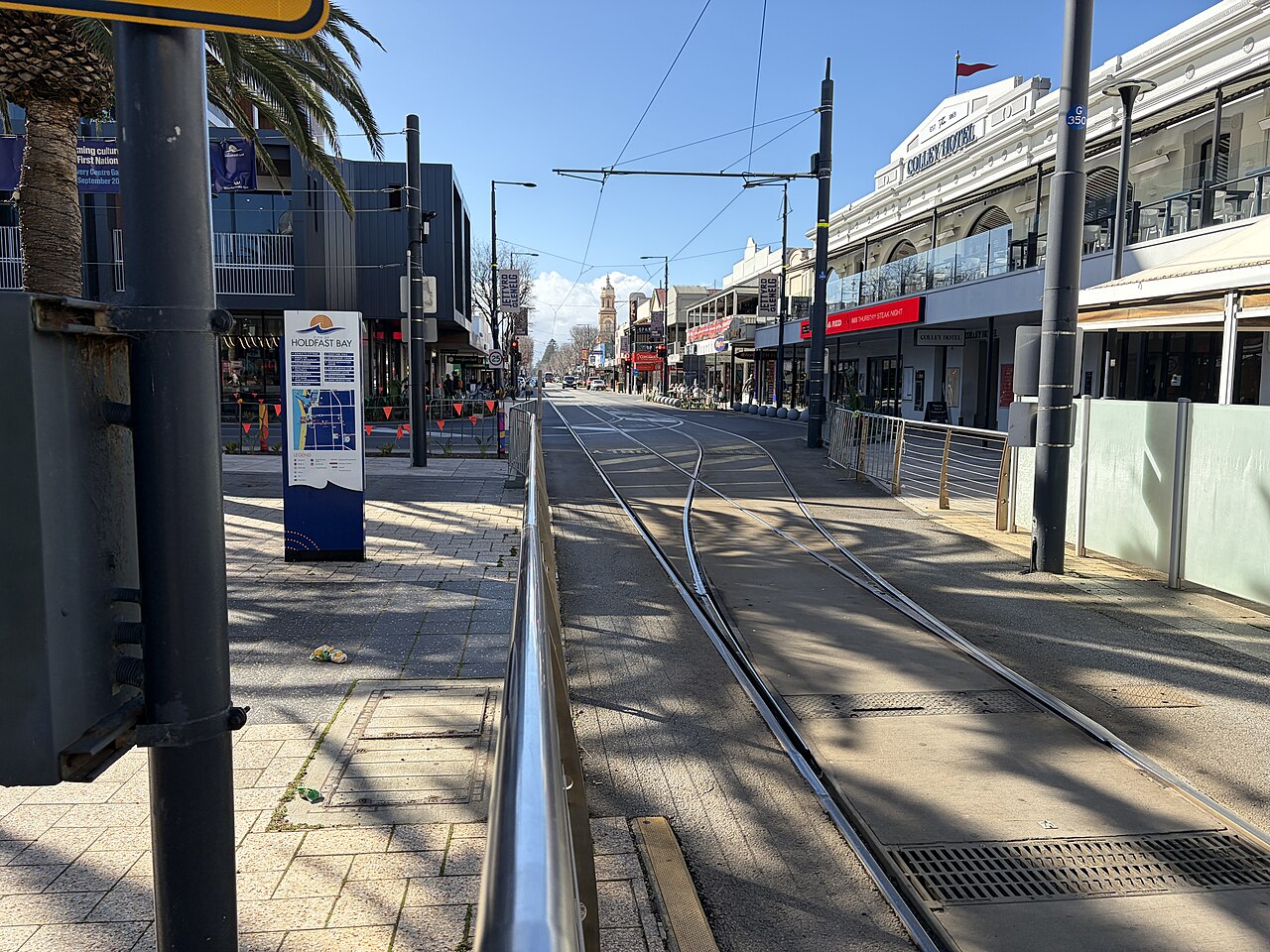
Every comparison of the beach suburbs ends up measured against Glenelg, and for good reason. It is the one with the tram, which runs straight up to the city centre, the biggest choice of hotels and apartments, a shopping and dining strip on Jetty Road, and the most going on after dark. For a first visit without a car, it is the simplest choice, and our Glenelg guide and Glenelg accommodation guide cover it in detail.
The trade-off is that Glenelg is the most touristy of the beach suburbs. It is busier, it charges more for comparable accommodation, and it has more chains and fewer local quirks. Many repeat visitors switch to Brighton or Henley once they know the city — close enough to use Glenelg’s attractions, far enough away to sleep in a quieter street.
Also worth a look
- Largs Bay: north of Semaphore, with a jetty, a long quiet beach and the landmark Largs Pier Hotel of 1882. Even quieter than Semaphore, on the same train line.
- Grange: just north of Henley, with its own jetty and a railway terminus. It gives you Henley’s restaurants within walking distance and a train to the city.
- West Beach: between Henley and Glenelg and the closest beach to the airport, with large holiday parks and the coastal path on the doorstep.
- Seacliff: just south of Brighton on the Seaford line, where the coast starts to rise into low cliffs. Calmer still, with a beach that suits families.
- Further south: Port Noarlunga and the southern beaches are better for a day trip or a base for McLaren Vale than for city sightseeing. See our McLaren Vale day trip for combining wine and beaches.
What a day looks like in each
The quickest way to feel the difference between the suburbs is to imagine an ordinary summer day in each one.
A day in Semaphore
Coffee on Semaphore Road, then down to the beach before the sea breeze arrives. Walk the jetty, give the kids a turn on the carousel and an hour at the waterslides, and eat fish and chips on the foreshore lawns. In the afternoon, drive ten minutes to Port Adelaide for the maritime and railway museums, or look for dolphins in the Port River. Back for a swim as the heat drops, then a film at the Odeon Star or a quiet drink on the main street. By 10pm the town is asleep, which is exactly what some people come for.
A day in Henley Beach
An early walk or ride along the coast path to Grange and back, and breakfast facing the water. Head into the city for the museums or the Central Market — it is the closest of the beach suburbs — or spend a lazy day between the sand and a café. The evening is the main event: a drink on the square as the sun drops, dinner at one of the foreshore restaurants, and a stroll to the end of the jetty in the last of the light.
A day in Brighton
A morning swim at the least hazardous beach on the list, then coffee on Jetty Road, Brighton. Take the train into the city for an afternoon on North Terrace, or walk the Esplanade north to Glenelg for a change of pace. Back in time for a film at the Windsor or a meal at the Espy, and a sunset from the jetty. It is the most balanced of the four: beach, city and a quiet night, with no car needed.
A day in Glenelg
Breakfast on Jetty Road, a swim off the main beach, and the tram into the city before lunch. Afternoon at the Art Gallery or the Botanic Garden, tram back for a sunset on the jetty, and dinner and drinks on the strip as it fills with people. It is the easiest day of the four and the most crowded, and in January every one of those steps involves a queue.
The coast through the seasons
- Summer (December to February): peak season. Long light evenings, afternoon sea breezes and full beaches, especially on weekends and through the January school holidays. Book accommodation well ahead and expect higher prices. Our Adelaide in summer guide covers heatwave days and events.
- Autumn (March to May): quite possibly the best time for a beach stay. The water is at its warmest after a summer of sun, the crowds thin once school goes back, and settled, sunny weather is common. See Adelaide in autumn.
- Winter (June to August): cool, sometimes stormy, and very quiet. Rentals are cheaper, the sunsets can be spectacular, and a winter walk along the jetty followed by a pub meal has its own appeal. Swimming is for the brave.
- Spring (September to November): warming days but still-cold water and frequent wind. Good for walks and cycling along the coast path, less so for lazing on the sand. The patrol season starts as the weather warms towards summer.
Practical things to know about the beach suburbs
- The coast path links them. A shared walking and cycling path runs along much of the metropolitan coast, and it is the nicest way to travel between neighbouring suburbs. Walking from Henley to Glenelg, or Brighton to Glenelg, makes a good morning. Our cycling guide covers bike hire.
- Swim between the flags. Surf Life Saving clubs patrol the main beaches on weekends and public holidays through the warmer months. Outside those times and places, you are on your own. Adelaide’s metropolitan beaches are generally gentle, but conditions change with the wind.
- Afternoon sea breezes are normal. Mornings are often calmest for swimming. In summer, a sea breeze usually arrives in the afternoon and freshens things up.
- Seagrass happens. After storms, banks of dead seagrass can wash up on some beaches. It is natural and harmless, just less photogenic.
- Dogs: rules on dogs vary by council, beach and season, and many beaches restrict dogs during summer daytime hours. Check the signs at each access point.
- Parking: summer evenings and weekends fill the foreshore car parks at all four suburbs. Arrive early or come by public transport.
Where to stay: our verdict
| If you are… | Base yourself in… | Why |
|---|---|---|
| A first-time visitor without a car | Glenelg | The tram into the city and the widest choice of places to stay |
| A couple who loves food | Henley Beach | Dinner on the square, sunsets on the jetty |
| A family with young kids | Brighton or Semaphore | Calm swimming at Brighton; carousel, waterslides and value at Semaphore |
| Wanting quiet but connected | Brighton | A train to the city and a peaceful beach |
| Travelling on a budget | Semaphore or Largs Bay | Lower prices and holiday-park options |
| Flying in late or out early | Henley Beach or West Beach | The closest beach bases to the airport |
If you are still undecided between the beach and the city, our where to stay in Adelaide guide compares the beach suburbs with the CBD, North Adelaide and the Hills. Families should also see the best family beaches.
Adelaide beach suburbs FAQ
Which Adelaide beach suburb is best to stay in?
It depends on what you want. Glenelg is the most convenient, with a tram to the city and the most hotels. Henley Beach is best for food and sunsets, Brighton for calm swimming and a train to the city, and Semaphore for character and value.
Which beach suburbs have a train to the city?
Brighton and Seacliff are on the Seaford line, Semaphore and Largs Bay are served by the Outer Harbor line (Semaphore’s station is Glanville), and Grange has its own line. Glenelg has the tram. Henley Beach relies on buses.
How far is Semaphore from the Adelaide CBD?
About 14km. Trains from Glanville station on the Outer Harbor line run every 30 minutes, and the drive takes 20–30 minutes.
Is Henley Beach or Glenelg better?
Glenelg is busier and better connected, with the tram and more hotels. Henley Beach is quieter, closer to the city and the airport, and better for foreshore dining, but it has no train.
Is Brighton beach good for swimming?
Yes. Surf Life Saving rates it in its least hazardous category, and it is patrolled on weekends and public holidays from November to March. The Brighton Jetty Classic open-water swim is held there on the first Sunday in February.
Do all Adelaide beaches have sunsets over the sea?
The metropolitan beaches all face west across Gulf St Vincent, so yes. Every jetty from Semaphore to Brighton is a sunset spot on a clear evening.
Related Adelaide Guides
- Best Beaches in Adelaide — the beaches themselves, compared.
- Glenelg — the busiest beach suburb, in detail.
- Glenelg Accommodation — hotels and apartments by the bay.
- Where to Stay in Adelaide — beach, city or hills.
- Best Family Beaches — safe swimming for kids.
- Port Adelaide — museums and dolphins next door to Semaphore.
- Adelaide Waterfront Dining — tables with a sea view.
- Adelaide Beaches & Nature — the coast and the outdoors, all in one place.
Photo Credits
Semaphore Road and the Time Ball Tower: “Semaphore road looking towards the beach.jpg” by AlphaLemur, via Wikimedia Commons, CC BY 4.0.
Kites over Semaphore jetty: “Semaphore Jetty, Adelaide (DSCF4186).jpg” by Yu Chu Chin, via Wikimedia Commons, CC BY-SA 4.0.
Henley jetty at sunset: “Henley Jetty (131914601).jpeg” by Shav Bird, via Wikimedia Commons, CC BY 3.0.
Brighton jetty at sunset: “Brighton-201212-03.jpg” by eosdude, via Wikimedia Commons, CC BY-SA 2.0.
Jetty Road, Glenelg: “Glenelg, South Australia 20260820-102458.jpg” by RegionVisitor90, via Wikimedia Commons, CC BY 4.0.
Semaphore jetty and beach (featured image): “Semaphore Jetty, Adelaide (DSCF4231).jpg” by Yu Chu Chin, via Wikimedia Commons, CC BY-SA 4.0.