For nine days every September, a block of Wayville just south of the city parklands becomes the most crowded place in South Australia. Stud cattle are hosed down and blow-dried a short walk from a sideshow alley that runs until 11pm, children study the showbag list with the focus of stock traders, and the last trains back to the city are full of people clutching oversized plush prizes. The Royal Adelaide Show has been held in some form since 1840, it draws more than half a million visitors a year, and for a lot of Adelaide families it is a fixed point on the calendar in a way that no arts festival quite manages.
This guide covers what you need to plan a visit: the 2027 dates (4 to 12 September), what tickets cost and where to buy them (not at the gate any more), how rides and showbags work, what is on in the pavilions and the main arena, the easiest way to get there, and an honest view of where your money goes furthest. Prices are the official 2026 prices, checked in October 2026 on the Show’s own website. The 2027 prices had not been released, so treat them as the right order of magnitude.
The Royal Adelaide Show at a glance
| What | The short answer |
|---|---|
| Next Show | Saturday 4 to Sunday 12 September 2027, nine days |
| Last Show | Saturday 5 to Sunday 13 September 2026 |
| Hours | Gates 9am to 11pm daily; the final Sunday closed at 10:30pm in 2026 |
| Where | Adelaide Showground, Goodwood Road, Wayville, about 2.5km south-west of the city centre |
| Adult entry (2026) | A$29 weekdays, A$35 weekends; A$26 / A$29 after 6pm, online only |
| Child entry, 5 to 14 (2026) | A$17 weekdays, A$21 weekends; under-5s free |
| Family ticket (2026) | A$69 weekdays, A$82 weekends, for two adults and two children or one adult and three |
| Rides | Not included. The discounted online carnival pass was A$80 in 2026 and sold out |
| Showbags | Extra. The full list, with every bag’s price, goes online before the Show |
| Where to buy tickets | Online, or at Drakes Supermarkets. There are no ticket boxes at the gates |
| Getting there | Train to Adelaide Showground station, which sits beside the grounds |
| Crowds | More than 500,000 visitors over the nine days; weekends are the crush |
When is the Royal Adelaide Show?
The Show runs for nine days at the start of September. In recent years it has opened on a Saturday and closed on the Sunday of the following weekend, which gives you two weekends and the five weekdays between them. The 2026 Show ran from 5 to 13 September. The 2027 Show is confirmed for Saturday 4 to Sunday 12 September 2027.
It sits outside the school holidays. September falls in South Australia’s Term 3, so on weekdays you share the grounds with school groups, retirees, farmers in town for the judging and parents with preschoolers, rather than with every family in the state at once.
Opening hours
In 2026 the gates opened at 9am and closed at 11pm every day except the final Sunday, when the Show shut at 10:30pm. Expect the same pattern in 2027, but check before you go. Not everything runs the full fourteen hours: pavilion displays, animal sections and the competition judging keep their own timetables, and the main arena works to a daily program. If there is one thing you have come to see, a particular breed of cattle being judged or the woodchop final, look it up on the day’s program before you plan anything else around it.
What the weather does in early September
This is the hinge between winter and spring. Days usually reach the high teens, nights fall below 10°C, and a day of passing showers is entirely normal. The Showground is a campus of pavilions with open ground between them, so you are in and out of the weather all day, and the night show in the main arena is a cold hour on a stand without a proper jacket. Layers, a waterproof and comfortable shoes are the uniform. Our guide to Adelaide in spring has more on what September is like.
Royal Adelaide Show tickets
These are the official 2026 prices. Entry covers the grounds, the pavilions, the animals and the arena program. Rides and showbags cost extra.
| Ticket | Mon–Fri | Sat–Sun | After 6pm Mon–Fri (online) | After 6pm Sat–Sun (online) |
|---|---|---|---|---|
| Adult (15 and over) | A$29 | A$35 | A$26 | A$29 |
| Child (5 to under 15) | A$17 | A$21 | A$15 | A$19 |
| Child (under 5) | Free | Free | Free | Free |
| Concession, including students | A$23 | A$28 | – | – |
| Family (2 adults + 2 children, or 1 adult + 3 children) | A$69 | A$82 | – | – |
Where to buy, and why the gate will not help
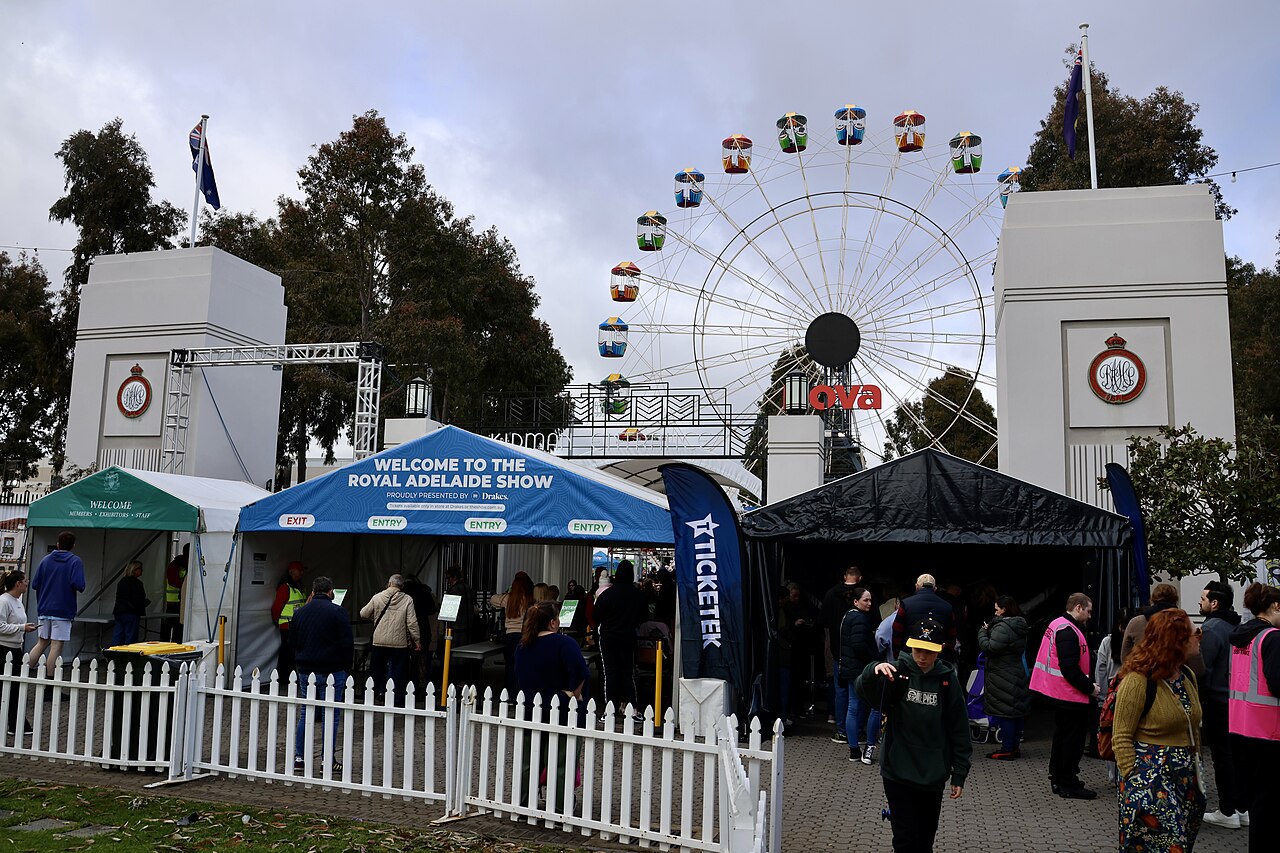
At the 2026 Show there were no ticket boxes at the gates. Tickets went on sale at 9am on Friday 31 July and were sold two ways: online through the Show’s website, and over the counter at any of 46 Drakes Supermarkets around the state. If you arrive without one, roving staff at the entrance will help you buy online on the spot, but that is card only, with no cash accepted.
The useful local detail is the Drakes on the corner of Goodwood Road and Young Street, directly across the road from the Showground. It sells Show tickets for cash or card, which matters if your phone is flat, your banking app is sulking, or you simply prefer a paper ticket in your hand.
Weekday or weekend?
From 2026 you no longer pick a specific date. You buy either a weekday ticket, valid on any day from Monday to Friday, or a weekend ticket, valid on either the Saturday or the Sunday. A weekday ticket will not get you in at the weekend, and the Show does not swap days once you have bought, so be honest with yourself about when you will actually go.
If you have the choice, go on a weekday. An adult saves A$6, a family saves A$13, and the difference in crowds is the bigger saving. On a weekend afternoon the carnival queues stretch, the showbag halls are a scrum, and finding a table at lunch becomes a competitive sport. A Tuesday morning at 9am is a different Show.
Family tickets, concessions and carers
The family ticket is genuinely good value if it fits your group. Two adults and two children on a weekday would pay A$92 on individual tickets, against A$69 for the family ticket, a saving of A$23. At the weekend the gap widens to A$30 (A$112 against A$82). One adult with three children saves A$11 on a weekday and A$16 at the weekend. The catch is that everyone on a family ticket has to enter together, so it does not work if one parent is coming straight from work.
Concession tickets are available to full-time students aged 15 and over with current student ID, holders of a Department of Veterans’ Affairs White or Gold Card, SA Seniors Card holders, and anyone with a Centrelink Pensioner Concession Card or Health Care Card. Children aged four and under do not need a ticket at all.
If you hold a Companion Card, your carer gets in free. Show your own pre-purchased ticket at the entrance with a valid Companion Card and the carer walks in with you; there is no separate companion ticket to book, and it is one carer per person.
The after-6pm ticket
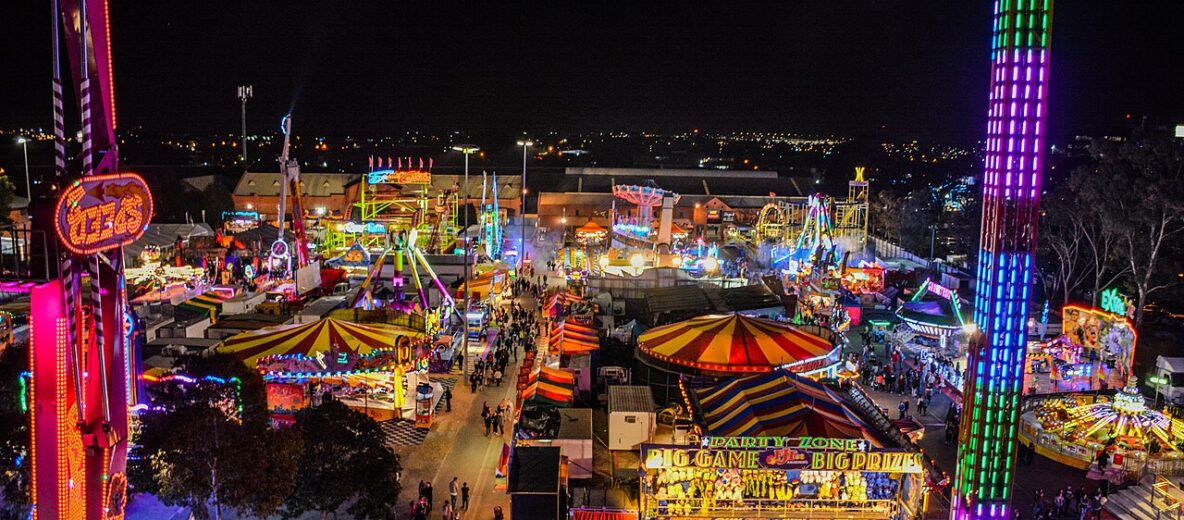
Sold online only, the twilight ticket takes A$3 off an adult weekday entry and A$6 off at the weekend. It is a modest discount, but for adults without children it is the smartest way to do the Show. Five hours is plenty for a lap of the food stalls, a ride on the Ferris wheel, the carnival lit up after dark and the night show in the main arena, and the evening crowd is a different mix: couples, groups of friends, teenagers on their own for the first time. What you lose is the daytime agricultural program, so if the animals are the point, go early instead.
Rides and the carnival
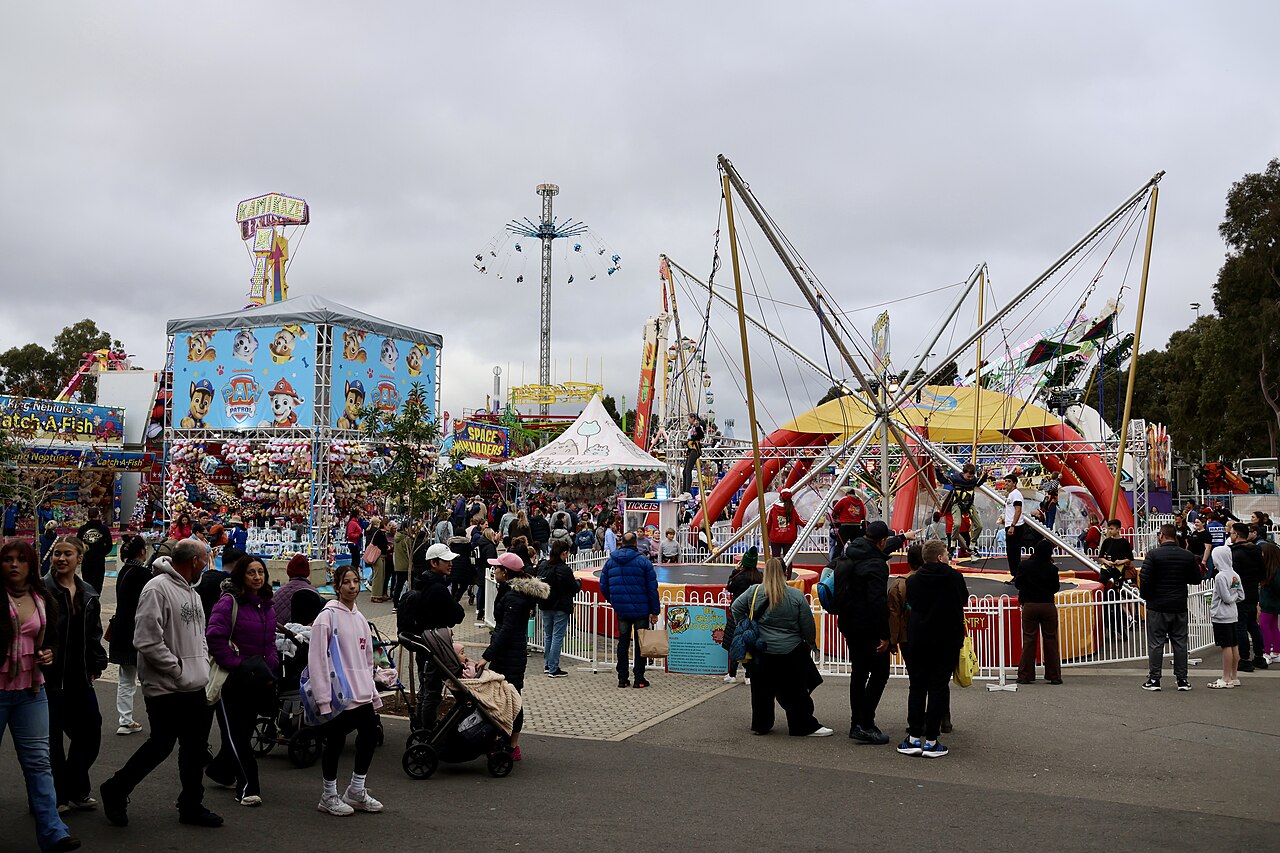
The carnival, which most South Australians still call sideshow alley, fills a big slice of the Showground with rides, game stalls and food vans. The line-up changes every year and is posted on the Show’s website before opening day, so you can see in advance whether this is the year of the giant drop tower or the year of the spinning teacups. In 2025 it included the Sky Flyer XXL, a swing ride that lifts its chairs high above the grounds on a lattice tower, alongside the Ferris wheel near the main gates and the usual run of dodgems, slides and kiddie rides.
Rides are not included in your entry. You either pay at each ride or buy a carnival pass for unlimited rides. In 2026 a discounted carnival pass cost A$80 online, and it sold out, which tells you how many families had done the maths. If a child is going to ride all afternoon, a pass is the only way it adds up. If your children are small, or you are mainly there for the animals and the food, pay as you go and stop when the novelty wears off.
Two things before you buy a pass. First, check the height limits for the rides your children actually want; a pass is wasted money on a child who is too short for half of them. Second, a pass buys rides, not time, and on a weekend afternoon the queues for the big rides eat into how many you can fit in. On a weekday morning, a pass goes a lot further.
The game stalls, the knock-’em-downs, water-pistol races and laughing-clown heads, are part of the fun, but nobody walks away ahead. You will almost always spend more than the prize is worth. Set a budget, hand it over in cash or a fixed number of goes, and treat it as entertainment rather than shopping.
Royal Adelaide Show showbags
Showbags began as free sample bags handed out by manufacturers early in the twentieth century. They now cost real money, they are sold from dedicated showbag halls and kiosks around the grounds, and choosing them is, for a certain age group, the main event.
The Show publishes its showbag list online before the gates open, with every bag, its contents and its price. Use it. Sit down with the children and the list the night before and agree on a number and a budget. It turns an hour of negotiation under fluorescent lights into a ten-minute errand, and it stops the classic mistake of blowing the whole budget on the first bag you see.
Prices run from a few dollars for the old-school confectionery bags, with the Bertie Beetle bag being the classic, up to A$30 or more for the big character and toy bags. Some of the expensive ones are good value; some are mostly packaging and a plastic toy. Read the contents list rather than the picture on the front.
Buy them on your way out if you can. Showbags are bulky, a full one is heavier than it looks, and carrying four of them around the pavilions all afternoon is nobody’s idea of a good day. Bring a backpack or a foldable bag for the trip home.
The animals, the competitions and the pavilions
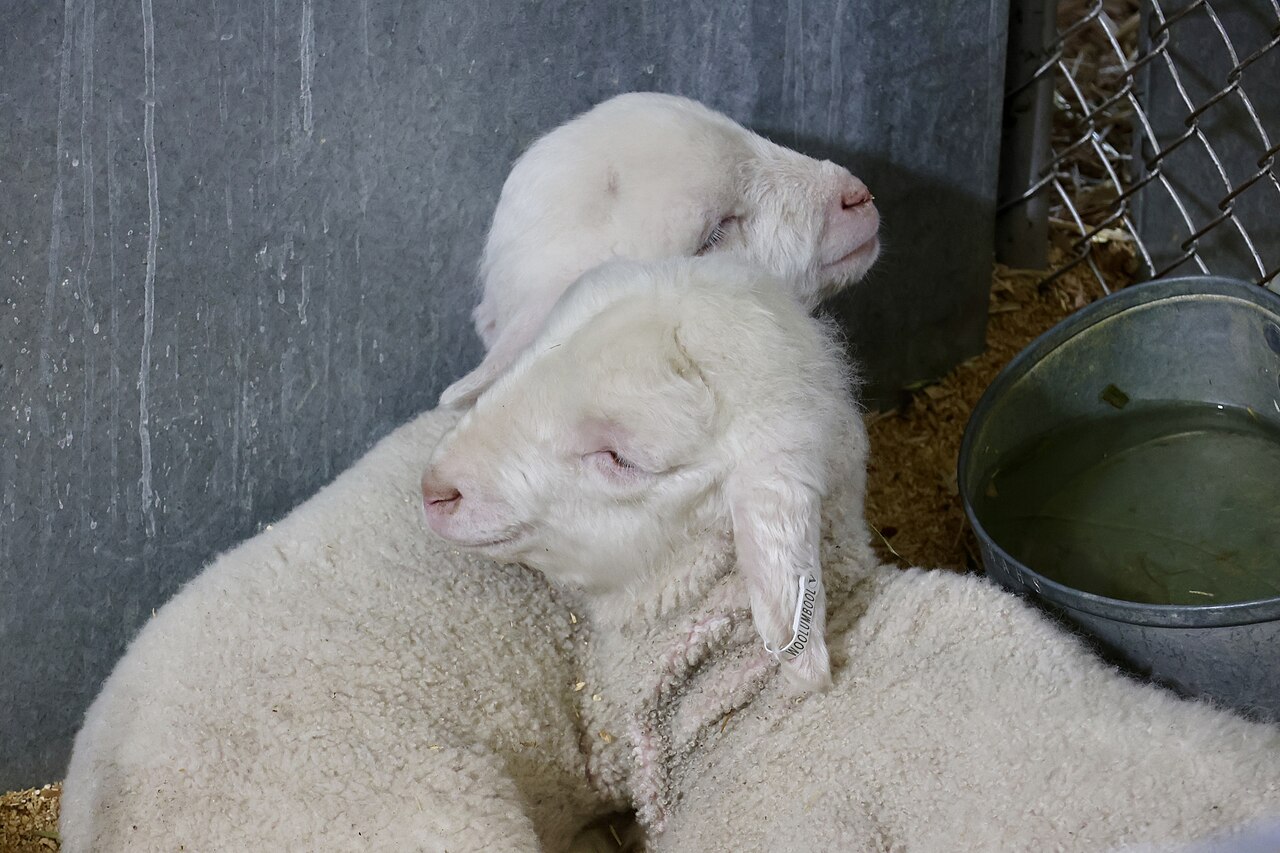
Under the fairy floss, this is still an agricultural show, and that is the part first-timers most often skip and then wish they had not. The Show is run by the not-for-profit Royal Agricultural and Horticultural Society of South Australia, which was founded in 1839 to promote farming in the young colony, and more than 31,000 entries now compete across 63 sections every year: livestock, pets, art, cookery, produce, wine and other drinks, and displays of skill.
For city children, and plenty of city adults, it may be the only time they see a stud bull up close, watch a sheep being prepared for judging or realise how big a draught horse actually is. A few things are worth seeking out:
- The livestock pavilions. Cattle, sheep, goats, pigs and poultry are groomed, shown and judged over the nine days, and exhibitors are usually happy to talk if you catch them between classes.
- The animal contact areas. The smaller animals are there to be patted. The Show publishes animal contact guidelines, and washing hands afterwards is not optional.
- The woodchop. Axemen racing through blocks of timber has been a Show fixture for generations, and it is one of the most watchable things on the grounds.
- The competition halls. Cakes, preserves, flowers, art and photography, each with its rosettes and ribbons. Gently old-fashioned and oddly absorbing, especially when you find a prize-winning sponge from a town you drove through yesterday.
- The shopping halls. Exhibitors selling everything from spas and mattresses to kitchen gadgets demonstrated with total conviction. You do not have to buy the miracle mop, but you will probably watch the demonstration.
Look out too for the Goyder Pavilion, the Showground’s big modern exhibition hall. Its roof carries around 10,000 square metres of solar panels, one of the largest rooftop installations in Australia when it went in, and enough for the Showground to be registered as a power station.
The main arena and the night show
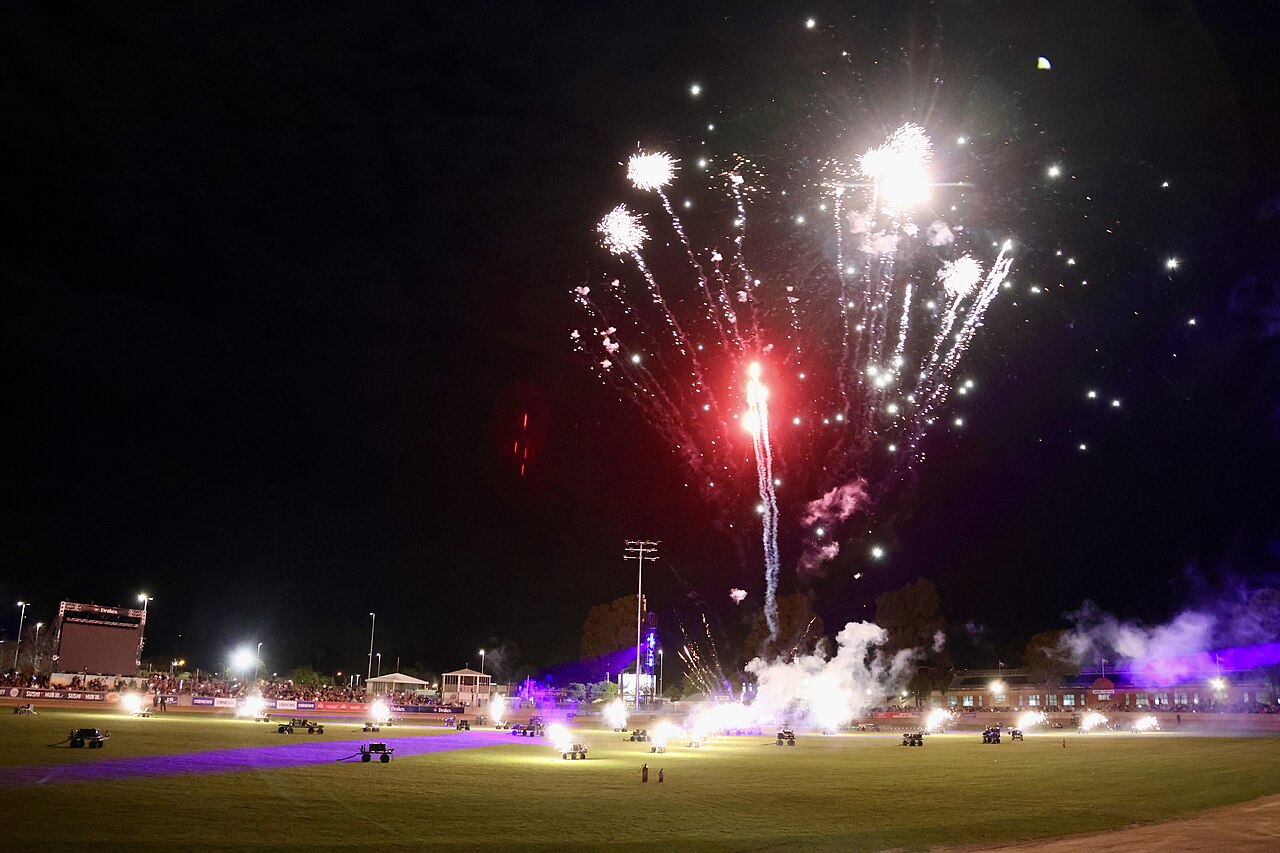
The main arena is the big oval at the heart of the Showground, ringed by a dirt track, with old-fashioned grandstands along one side. By day it is used for horse events and livestock parades, the old heart of any agricultural show. At night it turns into an entertainment venue.
The evening program changes every year. In 2025 it featured freestyle motocross riders throwing bikes high over the arena, stunt drivers sliding cars around the dirt track, and a closing display of fireworks fired from the arena floor. Check what is scheduled for your night and when, and get to the stands early on a weekend if you want a seat rather than a view of someone’s shoulders.
The arena has its own history. Between 1926 and 1934 it hosted motorcycle speedway as the Speedway Royal, promoted in 1928 as “The World’s Fastest Dirt Track Speedway”, and the egg-shaped track laid down then is still the shape of the arena today.
Food at the Show
Nobody goes to the Show for value dining. The carnival classics are all here, from dagwood dogs and hot chips to doughnuts, fairy floss and soft-serve, alongside food trucks and stalls selling just about every cuisine Adelaide eats. Prices are what you would expect at a captive-audience event, and lunchtime queues at the busiest stalls are long on weekends.
A few ways to make it easier. Eat early or late rather than at 12:30 on the dot. Agree before you go on what counts as a treat and what counts as a meal, because the Show is very good at turning one into the other. Bring water bottles and snacks for small children, but check the conditions of entry on the Show’s website first for what you can bring in. And if you are staying in town, fill up before you go: the Adelaide Central Market is on the south-west side of the city, so it is a natural breakfast stop on the way down.
What a day at the Show really costs
Entry is the smallest part of the bill for most families. Here is a realistic picture for two adults and two children. Entry and the carnival pass are the official 2026 prices; the other lines are budgeting allowances, not quoted prices.
| Item | Lean weekday | Big weekend day |
|---|---|---|
| Entry | A$69 family ticket | A$82 family ticket |
| Rides | A handful paid ride by ride: allow A$30–50 | Two carnival passes: A$160 at the 2026 online price, more if bought later |
| Showbags | One each for the children: allow A$30–40 | Four bags: allow A$80–120 |
| Food and drink | Snacks from home, lunch bought there: allow A$50–70 | Lunch, dinner and treats: allow A$120–160 |
| Rough total | About A$180–230 | About A$440–520 |
The gap between those two columns is almost entirely rides and showbags, which is where planning pays. For more ways to stretch a holiday budget in the city, see our guide to Adelaide on a budget.
Getting to the Adelaide Showground
The Showground sits in Wayville, just south of Greenhill Road and the South Parklands, bordered by Goodwood Road on the east, Leader Street on the south, Rose Terrace on the north and the railway line on the west. It is close enough to the city that you should not need a car.
By train
This is the easy one. Adelaide Showground station sits right beside the grounds on the Belair and Seaford lines, a few minutes from Adelaide Railway Station on North Terrace. The permanent station opened in February 2014, replacing the temporary platform that used to be assembled each year just for the Show, along with the old Keswick station. Expect crowded platforms after the fireworks, when half the Showground leaves at once; waiting twenty minutes for the rush to clear is often quicker than joining it. Check current fares and ticket options before you travel; our Adelaide public transport guide explains how the network works.
Walking from the city
From Victoria Square it is about 2.5km, or roughly 30 to 35 minutes on foot. Head south out of the city, cross the South Parklands to Greenhill Road, and the Showground is just beyond it on Goodwood Road. It is a pleasant walk on a dry afternoon and a sensible way to skip the post-fireworks train queue on the way home, as long as you are with others and stick to the main roads at night.
Buses, taxis and rideshare
Adelaide Metro buses run along Goodwood Road on the Showground’s eastern side. Taxis and rideshare work fine on the way in, but at closing time expect queues, surge pricing and traffic on every road out of Wayville. Walking a few blocks away from the gates before booking a car makes pickup much easier. Our guide to getting around Adelaide compares the options.
Driving
Avoid it if you can. Parking near the Showground is scarce during the Show, the streets of Wayville and neighbouring suburbs fill early, and parking restrictions are enforced. If you must drive, consider parking further out near a station on the Belair or Seaford line and finishing the trip by train.
How to plan your day
The Show rewards a plan, even a loose one. This running order works for most families on a weekday:
- 9am: arrive at opening. Head for the animals first, while they are fresh, the exhibitors are chatty and the pavilions are quiet.
- Mid-morning: the competition halls, the woodchop and whatever is on in the main arena.
- 11:30am: early lunch, before the queues build.
- Afternoon: the carnival. If you have bought passes, this is where they earn their keep.
- Late afternoon: showbags, on the way towards the exit or to a bench where someone can mind them.
- Evening: if the children have the stamina, the carnival after dark and the night show. If they do not, go home happy; you have seen the best of it.
Practical bits that make the day smoother:
- Buy tickets before you leave home. There is no ticket box to fall back on at the gate.
- Agree on a meeting point you can all find, and write your mobile number on young children’s wrists or a wristband.
- Wear shoes you can walk in all day. The grounds are big and you will cover kilometres.
- Carry layers. A sunny 18°C afternoon becomes a cold, damp evening quickly in early September.
- Bring a backpack. Showbags, jackets and water bottles have to live somewhere.
Going with kids
The Show is built for children, and for once the brochure is not exaggerating. Under-fives are free, the animal areas are aimed squarely at them, and there is a gentler end of the carnival with rides sized for preschoolers. A pram or wagon helps with small legs and with the showbag haul, though it is hard work in the night-time carnival crowds.
Bear in mind that the fireworks and the motor shows are loud. Ear defenders are worth packing for younger or noise-sensitive children, or watch the fireworks from further back. And be realistic about stamina: a 9am to 11pm day is ambitious for adults, let alone a five-year-old. For more ideas, see our guides to Adelaide with kids and the city’s best family attractions. If the animals are the hit of the day, Adelaide Zoo and Cleland Wildlife Park make good follow-ups.
Is the Royal Adelaide Show worth it?
It depends on who you are and how you do it.
- Families with children under about 12: yes, without much argument. Go on a weekday, decide on rides and showbags before you leave home, and it is one of the best days out the city offers.
- Adults without children: yes, on a weekday evening with the A$26 twilight ticket. Come for the lights, a ride on the Ferris wheel, a dagwood dog and the night show. Paying full weekend price to wander around for three hours is harder to justify.
- Visitors from interstate or overseas: if you are in Adelaide in early September, go. It is a genuinely interesting slice of rural South Australia, the bit of the state that grows the food and wine you have been eating all week. It is not worth rearranging a trip around unless you love agricultural shows already.
What is not worth it: an unlimited carnival pass for a child too short for the big rides, the sideshow games if you are hoping to come out ahead, and showbags bought on impulse in the first hour. And if crowds are your idea of a nightmare, avoid the weekends entirely.
A short history of the Show
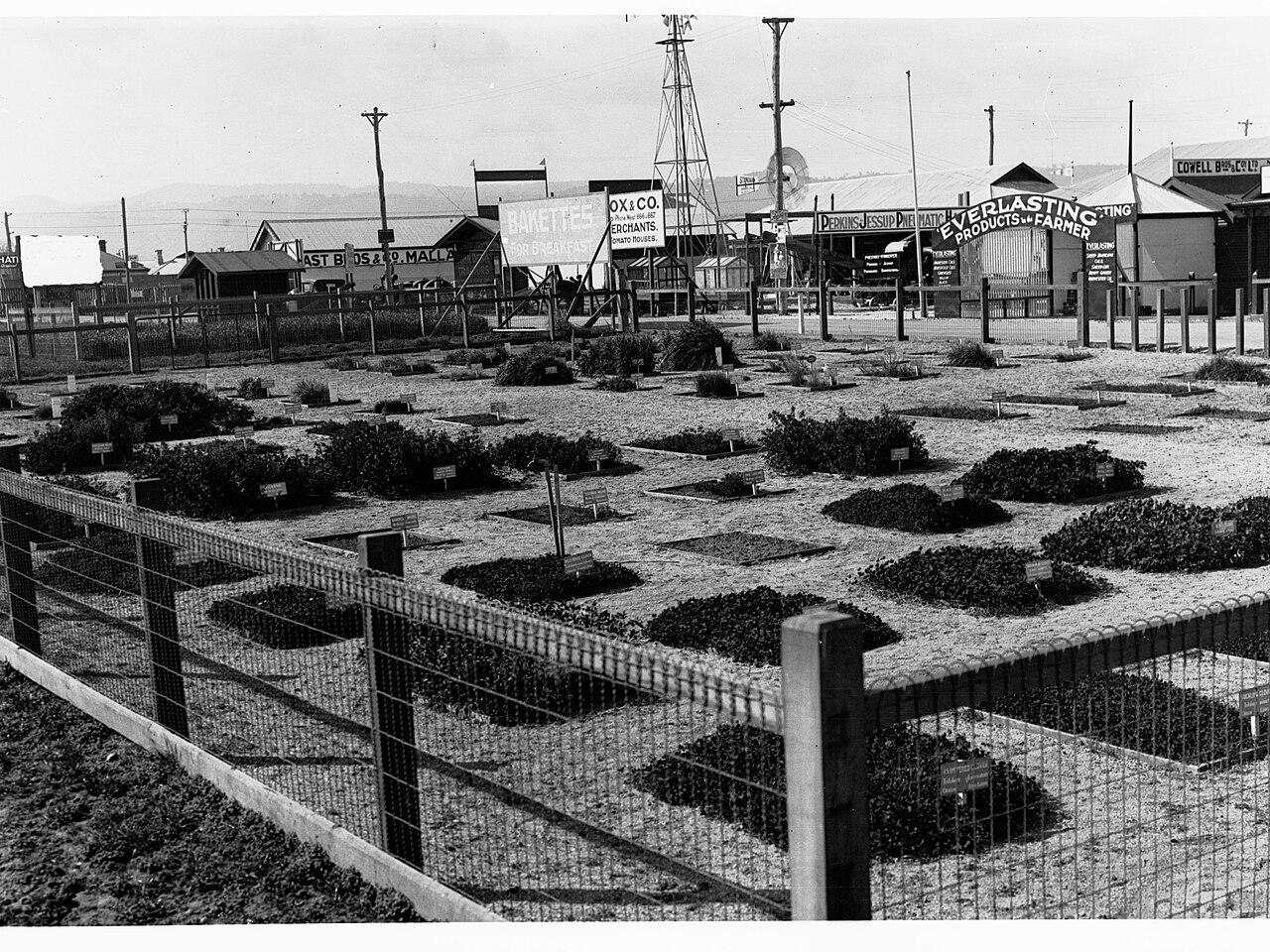
The South Australian Agricultural Society was founded on 28 October 1839, barely three years after the colony itself, “for the advancement of agricultural and pastoral knowledge”. Its first show, on 8 December 1840, was held in the yards of Fordham’s Hotel on Grenfell Street and was a modest display of vegetables, cereals, cheese, wool and leather. Livestock arrived in 1843, and from 1844 to 1859 the shows were held in Botanic Park. For many decades there were two a year, one in spring and one in autumn.
Royal patronage followed the visit of Prince Alfred, Duke of Edinburgh, in 1867: a special Grand General Show was staged while he was in Adelaide, and the society received his patronage the following year. From 1895 the autumn show moved to the Jubilee Exhibition Building on North Terrace, with horse events on the nearby Jubilee Oval, and the Show stayed in the city until 1924. There were no shows at all from 1915 to 1919, during the First World War and the influenza pandemic that followed.
In 1925 the Show became an annual event and moved to the purpose-built showground at Wayville, designed by C. R. Heath after a competition that drew fifty responses from every Australian state, New Zealand and England. It has been there ever since. The site is now known simply as the Adelaide Showground, and outside Show time it hosts more than 140 exhibitions and conferences a year, plus university exams and festival events such as the Augmented Games installation that headlined Illuminate Adelaide in July 2026.
The Royal Agricultural and Horticultural Society acknowledges the Kaurna people as the Traditional Owners of the land on which the Showground stands.
Royal Adelaide Show FAQ
When is the Royal Adelaide Show in 2027?
Saturday 4 to Sunday 12 September 2027. The 2026 Show ran from 5 to 13 September.
How much are Royal Adelaide Show tickets?
In 2026, A$29 for an adult on a weekday and A$35 at the weekend, A$17 and A$21 for children aged 5 to under 15, and A$69 or A$82 for a family. Online after-6pm tickets were cheaper, and under-fives were free. Prices for 2027 had not been released when we checked.
Can you buy Royal Adelaide Show tickets at the gate?
Not at a ticket box. In 2026 roving staff at the entrance helped people buy online, card only. Tickets were also sold at 46 Drakes Supermarkets, including one across Goodwood Road from the Showground that takes cash.
Are rides included in the entry ticket?
No. Rides are paid for separately, either per ride or with a carnival pass. The discounted online carnival pass cost A$80 in 2026.
What time does the Royal Adelaide Show open and close?
In 2026 the gates were open from 9am to 11pm daily, closing at 10:30pm on the final Sunday. Individual pavilions and animal displays keep shorter hours.
What is the best way to get to the Royal Adelaide Show?
By train. Adelaide Showground station is beside the grounds on the Belair and Seaford lines, a few minutes from Adelaide Railway Station. It is also about a 30-minute walk from Victoria Square.
Where can I see the Royal Adelaide Show showbags list?
On the Show’s official website, which publishes the full list with prices and contents before the Show opens each year.
How many people go to the Royal Adelaide Show?
More than 500,000 over the nine days, which makes it one of the biggest events in South Australia and one of the most attended shows of its kind in Australia.
Related Adelaide Guides
- Adelaide Events & Festivals — the full calendar, month by month.
- Adelaide in Spring — weather and events from September to November.
- Adelaide with Kids — the complete family guide to the city.
- Adelaide Family Attractions — the best days out for all ages.
- Adelaide Public Transport Guide — trains, trams and buses explained.
- Best Time to Visit Adelaide — what each month offers.
- Adelaide Wine Festivals — the state’s other great celebrations of what it grows.
- Where to Stay in Adelaide — the best areas for a short visit.
Photo Credits
The Show’s entrance in 2025: “Royal Adelaide Show 2025 – 01.jpg” by Yu Chu Chin, via Wikimedia Commons, CC BY-SA 4.0.
The carnival by day, 2025: “Royal Adelaide Show 2025 – 04.jpg” by Yu Chu Chin, via Wikimedia Commons, CC BY-SA 4.0.
Lambs in a pen, 2025: “Royal Adelaide Show 2025 – 22.jpg” by Yu Chu Chin, via Wikimedia Commons, CC BY-SA 4.0.
Fireworks over the main arena, 2025: “Royal Adelaide Show 2025 – 106.jpg” by Yu Chu Chin, via Wikimedia Commons, CC BY-SA 4.0.
Demonstration plots at Wayville, c. 1928: “Royal Adelaide Show, c. 1928(GN12615).jpg” by State Government Photographer, via Wikimedia Commons, CC0.
The carnival at night (featured image): “Royal Adelaide Show Night.jpg” by Max Ryszawa, via Wikimedia Commons, CC BY-SA 2.0.